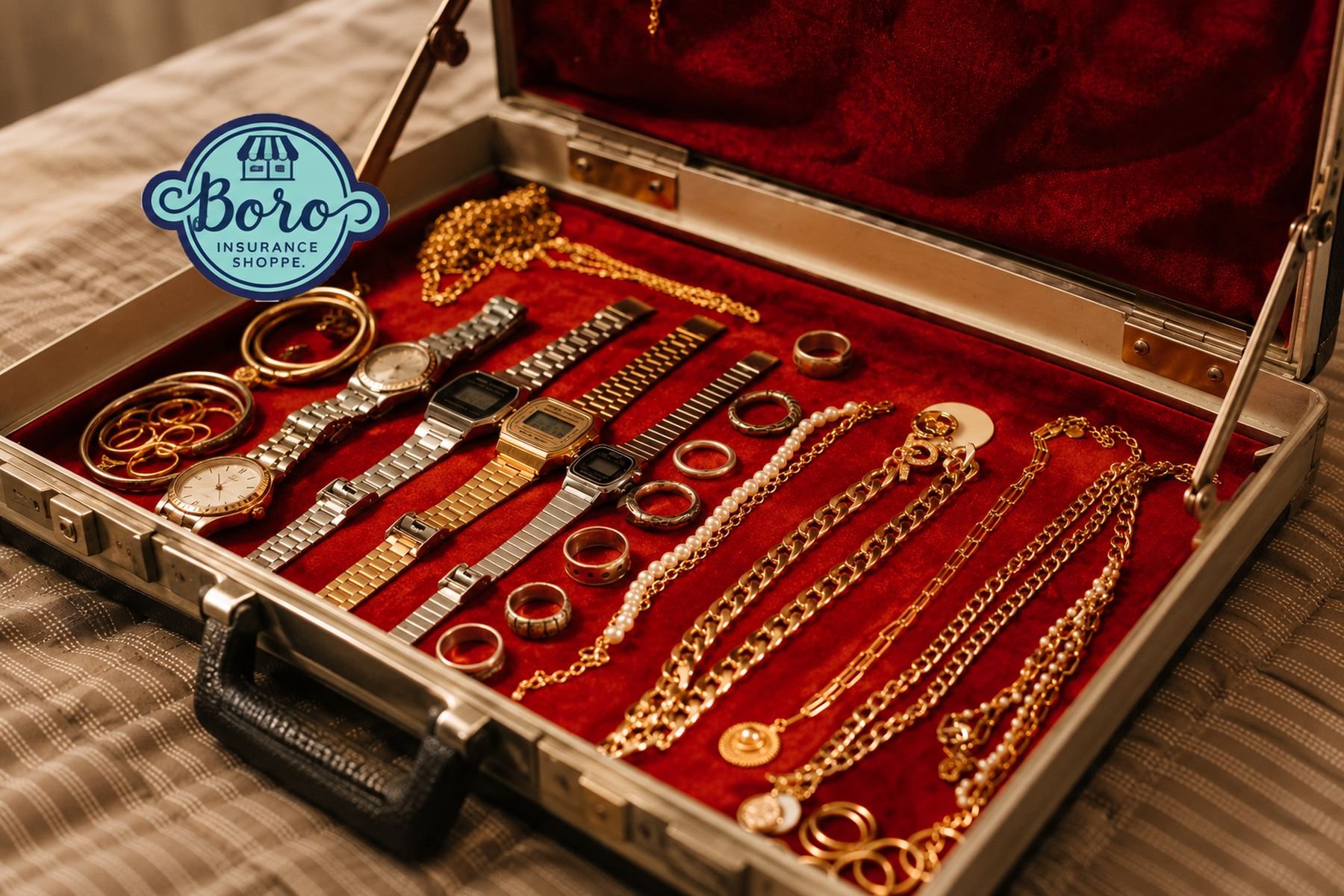
That diamond ring, gun collection or wall of Star Wars memorabilia may be covered by your homeowners policy, but important limits could leave you underinsured.
Insuring jewelry and collectibles properly starts with understanding those limits and deciding whether scheduled or blanket coverage is appropriate. Here’s what homeowners should know about protecting their valuables.
Most policies have built-in limitations for jewelry — commonly a $3,000, $5,000, or $10,000 cap — but there’s also a maximum you can collect per piece. Suppose you have a $5,000 jewelry limit with a $1,000-per-item maximum. If $10,000 worth of jewelry is stolen at once, the most you’d receive is $1,000 per item, up to that $5,000 total.
Worse, because that coverage is part of your base policy, your policy deductible applies first. With a $2,500 deductible, you’d absorb that amount before any payout. Between the per-item cap and the deductible, a serious loss can leave you badly under-compensated.
If you own items worth more than your policy’s per-item limit, the solution is scheduling them — adding them individually on a rider so they’re insured at their full appraised value. With a scheduled item, you receive the full value if something happens, and there’s typically no deductible because you’re paying a separate premium for that schedule.
Carriers usually require an appraisal once an item exceeds a threshold — often around $5,000 — to document exactly what it’s worth before adding it. The cost is very reasonable: figure roughly $10 per $1,000 of coverage for jewelry. A $5,000 ring runs about $50 a year to insure at full value.
Jewelry is the most overlooked, but it’s far from the only thing worth scheduling. Collectors should review coverage and limits for items such as:
Pricing varies by item and carrier, but many categories are even cheaper than jewelry. One client insured $60,000 worth of guns, and the gun rider cost about $40 for the entire year. Musical instruments are typically much less expensive to cover as well. Generally, insuring your valuables properly is inexpensive.
Scheduled coverage is broad. It generally covers theft, mysterious disappearance, and fire — and for jewelry it can even cover situations like a stone falling out of an engagement ring. That’s far more comprehensive than the limited, deductible-bound coverage built into a standard policy.
When insuring jewelry and collectibles, the choice between scheduled and blanket coverage depends on the value of individual items, the size of the collection and the options available from your insurer.
For a collection of many smaller items, a blanket with a reasonable per-item limit is often fine. But for any single high-value piece, scheduling it individually is the safest choice. Truly, itemizing is the best way to do it: there’s no question over replacement cost when each item is insured for its full value.
Sometimes. There are specialty, monoline carriers that insure only certain categories. For jewelry, for example, Jewelers Mutual does nothing but jewelry. You can place your jewelry schedule with them, off your homeowners policy — so if you have a claim, it stays on that policy and there are no repercussions for your homeowners coverage.
Insuring jewelry and collectibles starts with an accurate inventory. Keep a running list of your belongings, including their estimated values, photographs, purchase records, appraisals and serial numbers where available. Keep it current, and make sure your agent is aware of the collection, because your built-in collectible limit is almost certainly far below what you actually own.
Ready to protect what you’ve collected? Call The Boro Insurance Shoppe at 215-750-1030 and we’ll review your items and recommend scheduling or a blanket approach.